


How Addiction Opens the Door to Human Trafficking
Written By: Gabe Landau & Maribel Rivera
Trafficking rarely starts with a locked door. More often, it starts with a life already coming apart, and addiction is one of the fastest ways a life comes apart.
Here is a number that should stop us cold. Studies have found that somewhere between 68% and 88% of trafficking victims see a healthcare provider while they are being trafficked, and yet fewer than 5% of healthcare professionals have ever identified one. They sit in our waiting rooms. We treat them and send them home. And we almost never see what is actually in front of us.
That gap is not a rounding error. It is a system failing in plain sight. And one of the largest reasons it keeps failing is something we rarely connect to trafficking at all: addiction.
We tend to picture trafficking as abduction: a stranger, a van, a chain. The truth is quieter and far more common. Trafficking usually begins with instability, and few things destabilize a life faster than a substance use disorder. Addiction drains money. It strains housing. It frays the relationships a person would otherwise lean on when everything starts to slide. Those are not just consequences of addiction. To a trafficker, they are openings.
Because traffickers do not search blindly. They look for people who are already struggling, already isolated, already running low on options. Federal agencies have documented traffickers recruiting directly from detox facilities, treatment centers, and behavioral health clinics; the very places people go because they are trying to get better. Sit with that for a moment. The act of reaching out for help can be what puts someone on a predator’s radar.
A story We Don’t Tell Often Enough
She didn’t think of herself as a victim. She thought she had finally found someone who understood her.
Maddie was in her early twenties. A bad fall at work had turned into a prescription, and the prescription had turned into an opioid dependence, a path so common it has almost become background noise, except that nothing about living it feels ordinary. Her savings were gone. Her lease was shaky. The friends who used to call had mostly stopped.
Then someone showed up. He offered exactly what she needed: a place to crash, a way to keep the withdrawal at bay, something that looked like stability. At first, it genuinely felt like kindness.
- Then kindness curdled into expectation.
- Expectation hardened into pressure.
- Pressure became control.
The drugs her body now demanded became conditional. Compliance meant access. Resistance meant withdrawal, not as a threat, but as a punishment her own body would carry out on his behalf.
There were no chains. But leaving wasn’t an option because addiction had become the lock on the door.
The story above is a composite, drawn from patterns documented across many real cases. It does not depict any specific individual.
How the Cycle Actually Works
Human trafficking is often imagined as a crime of physical violence. Sometimes it is. But just as often, the restraints are psychological, financial, and chemical, and the chemical ones can be the strongest of all.
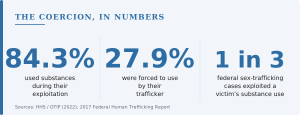
Traffickers introduce substances, sustain the dependency, and then withhold access to force compliance. The federal government now treats this as a recognized coercion tactic, and the survivor data is hard to look at. In the survey still most widely cited by U.S. agencies, 84.3% of trafficking survivors reported using substances during their exploitation, and 27.9% said their trafficker forced those substances on them. On the prosecution side, the pattern shows up again: traffickers exploited a victim’s substance use in roughly one in three federal sex-trafficking cases, more often than they exploited romantic relationships.
And the cycle feeds itself. Substance use increases vulnerability. Trafficking exploits that vulnerability. Exploitation deepens the dependency, sometimes because the trafficker engineers it, sometimes because substances become the only way to survive each day. Round and round it turns.
The opioid epidemic has poured fuel on all of it, widening the pool of people who can be exploited this way. Communities already under strain became easier prey. People already fighting for their lives against addiction were easier to control. Researchers and federal agencies increasingly describe the relationship as cyclical rather than one-directional, which is exactly why awareness campaigns that treat the two as separate problems keep coming up short.
This is not a crisis running parallel to trafficking. It is connected. In Part Two, we follow these victims into the one place almost all of them pass through, the healthcare system, and ask why that chance to intervene keeps slipping away.
A note on the data: the widely cited 84.3% and 27.9% figures originate from a 2014 survey of survivors that remains the most comprehensive of its kind and is still referenced by federal agencies today. Where possible, this series links to recent (2022–2025) sources that report and build on those findings.